A Coronavirus pivot: breaking down barriers to patient-centered care

Covid-19 has brought many changes to our lives, whether the penetration of video-conferencing to our lives, wearing face masks on a daily basis, or practicing social distancing. I found myself challenged by the need to continue to see patients face to face in the hearing clinic, yet trying to keep a distance. It's important to have an intimate setting for consultations and practically, it's critical to have a shared table for hearing aids and to review important documents.
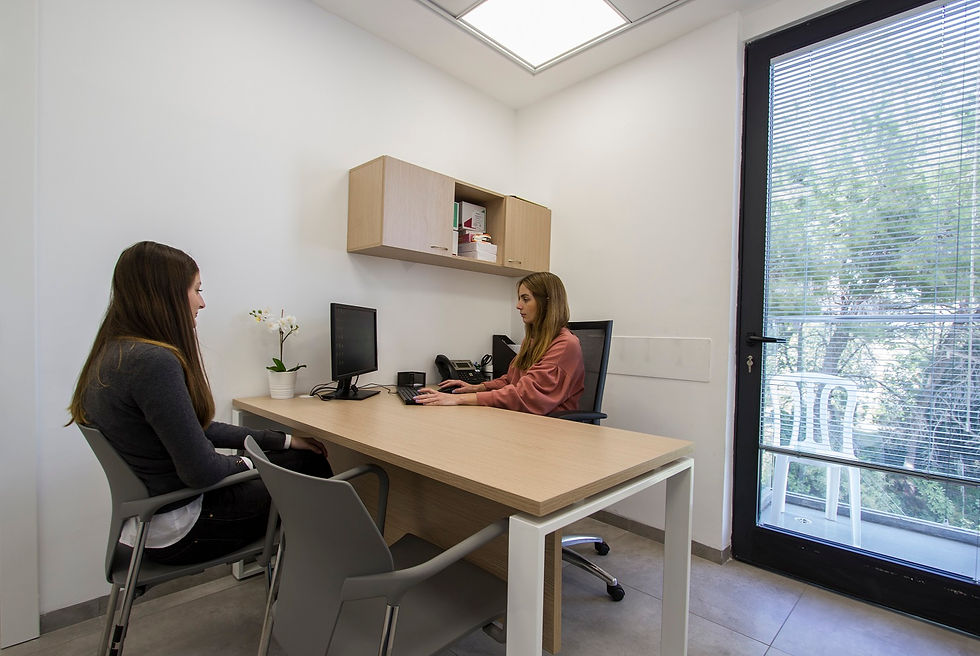
But first, let me start with a "fixedness" found in many clinics in Israel: the health care provider and patient are often sitting across a table from one another. The "third party", a computer with the electronic health record is always present, usually off to side.
So there I was, in the early days of the pandemic, naively thinking that by simply distancing the patient chairs about one meter (3 feet) back from the consultation table, I would be able to ensure a safe distance. The first patient to enter that morning immediately dragged the chair up to the table and promptly set their hearing aids on the table: "these aren't working". After a quick hearing aid tune up, the patient was on their way. I returned the chairs to their previous location and the next patient entered, sat down, and scooched themselves up to the table.
I quickly realized this was would become a lost battle with no winners.
So what could I do? For my 65+ year old patients, Covid-19 could be lethal and I felt a duty to do everything in my power protect them. On one hand, I didn't want to end up scolding them for dragging a chair up to the table, a rather natural reaction to the new set-up. Yet, distancing the patient's chair from the table felt like a move to even further disempower an often unbalanced relationship between provider and patient.
I knew I couldn't expect to receive a new and larger table that would enable us to all sit a the table at a distance - the healthcare system was scrambling for basic protective equipment. Fortunately, I grew up in a home where it was quite common to spontaneously rearrange the furniture. So the solution was simple: just rotate the table in the room
Instead of having patients sitting across from me and the table in between, they now sit at the end of the table, giving them access to use the table, place hearing aids or documents if needed. My computer workstation is at the far end of the table, so I can stay further away when recording information in the electronic record, and also come closer when needed - to check the hearing aid, show them how to change the volume, or check on the hearing aid placement.

But what I noticed after a few days, was that while a simple table rotation had allowed my patients and I to keep a safe distance, it had effectively brought us closer together.
Despite sitting further apart during consultations and follow-ups, we no longer had any physical barriers between us. Instead of sitting as "patient + caregiver" vs. "provider", we were now sitting in a circle. For me, it changed the atmosphere of the consultations and hearing aid fittings. I even found myself often showing how I'm adjusting the hearing aids on the fitting software, simply because the computer screen is much more accessible to the patient.
As it turns out, I wasn't the first to try a new furniture arrangement in a clinical setting. In fact, the famous Mayo Clinic published an innovative consultation room design in 2009. The room design included a round consultation table with a shared computer screen for both patients, caregivers and providers. In a randomized trial, some patients and providers used the newly-designed room, while some continued with the usual design. Overall, there wasn't a large difference in patient satisfaction with the communication quality or mutual respect. However, it was found that with the new design, providers were much more likely to share information, whether via the internet or in the electronic medical record with patients. It was concluded that the design of the consultation room can affect the clinical encounter (Almquist et al., 2009).
Although minimal, further research has been carried on the subject of room design and its impact on the patient-provider relationship. After completing a literature review, Bosch & Lorusso (2019) came to the conclusion that there is currently moderate evidence to support that the physical environment may affect patient and family-engaged care.
While I strive to practice patient centered care, the Covid-19 pandemic helped me realized that even the physical setting of the consult room can be a barrier to providing patient-centered care. Shari Eberts, a hearing aid user and hearing health advocate, recently wrote about the various barriers to practicing patient centered care for the Ida Institute.
Sometimes it takes a world-altering pandemic to break down barriers - we've seen how much healthcare has changed in the last six months. I hope that we won't have to wait for another external disruption to make further progress in providing patient centered care. We can all take action, even if it's a simple table pivot in the consultation room.
What can you do?
Patients: empower yourselves, ask questions, and seek out medical centers and providers who practice patient-centered care
Clinicians: start with small changes, even if it's just asking your patient's "What matters most to you?". If you're not sure how to have those conversations, look for continuing education opportunities, or even start by trying a simple furniture change in the consultation room.
Administration: Make patient-centered care a priority at all levels of healthcare, even the facility design. Not sure what works best for patients and providers? Foster collaboration and experimental projects, like the Mayo Clinic Center for Innovation.
Perhaps I discovered another silver lining to Covid-19: it pushed me to help break down another barrier to patient centered care, even if it was just a furniture re-arrangement.
Resources:
Almquist, J. R., Kelly, C., Bromberg, J., Bryant, S. C., Christianson, T. J., & Montori, V. M. (2009). Consultation room design and the clinical encounter: the space and interaction randomized trial. HERD: Health Environments Research & Design Journal, 3(1), 41-78.
Bosch, S. J., & Lorusso, L. N. (2019). Promoting patient and family engagement through healthcare facility design: A systematic literature review. Journal of Environmental Psychology, 62, 74-83.
Eberts, S. (2020, November 06). Overcoming barriers to person-centered care. Retrieved November 13, 2020, from https://idainstitute.com/what_we_do/news/detail/overcoming_barriers_to_person_centered_care/?utm_source=Newsletter

Comments